
Skip to content

Modules · Production and operations

Who can do which job, and why did that machine stop?

Skills matrix · Tooling and machines · Packing · Forms

Today

The line's only setter is off on the night shift; nobody knows who can step in. The downtime reason is written on a scrap of paper, and the tool change never reached anyone.

With DAMS

The skills matrix shows who can run which operation at which level. Operators start the work order at the kiosk and report downtime and tool changes; the office sees it at the same moment.

The gain

Critical operations no longer depend on one person. The contents of every shipped box can be traced back.

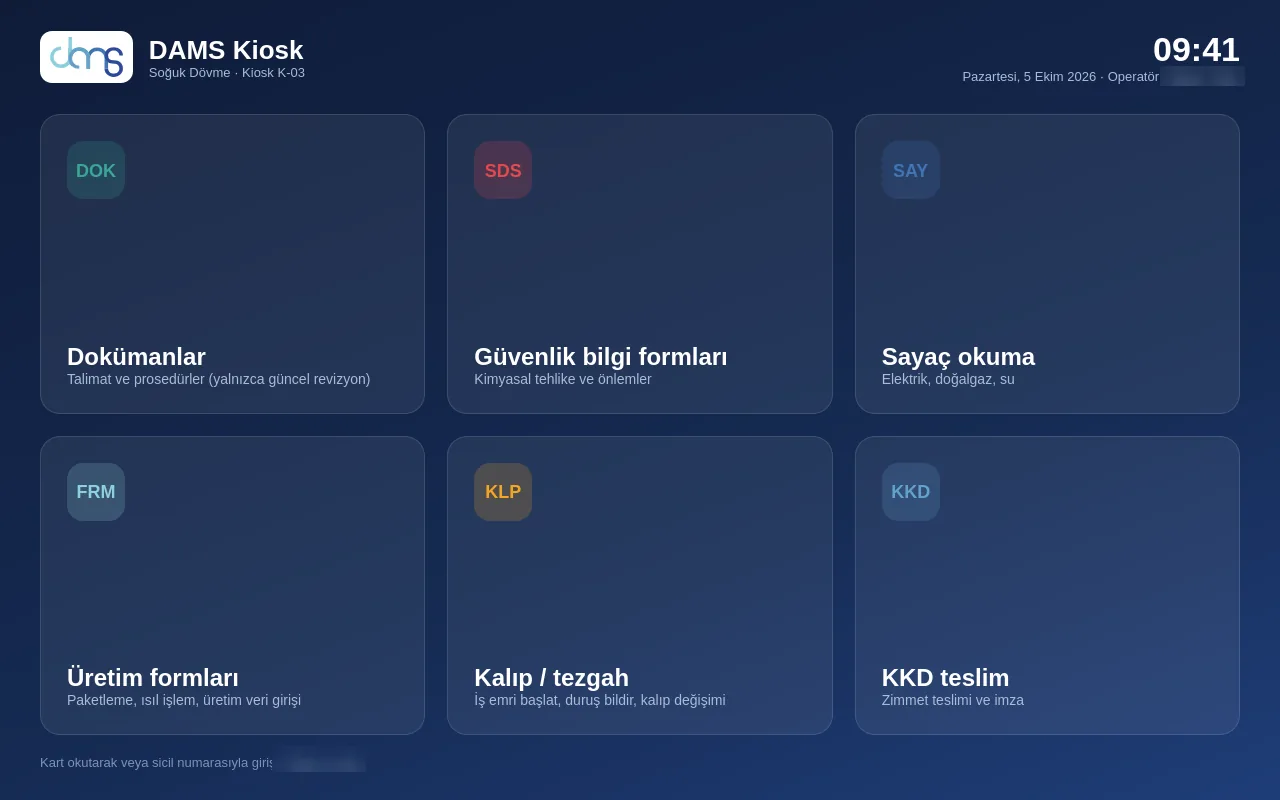
DAMS shop-floor kiosk: tiles for documents, safety data sheets, meter readings, production forms, tooling/machines and PPE issue (illustrative)
Shop-floor kiosk · illustrative
01

Skills matrix

Employee × operation matrix, levels 0–4, training gap analysis.

  • 0 not trained · 1 in training · 2 works under supervision · 3 works independently · 4 can train others.
  • A criteria table shows on what basis each level is granted.
  • Training gap analysis: shortfall against the target number of qualified people per operation.
  • Suggested training and employees for each gap.

Standard reference ISO 9001 7.1.2, 7.2 · IATF 16949 7.2.1, 7.2.2

02

Tooling management and machine monitoring

Tools, work orders, machines and downtime, fed by the kiosks on the shop floor.

  • A live card for each machine: running, down, tool change, planned maintenance, idle.
  • The card shows work order, tool no., produced / target quantity and progress.
  • Recent downtime: reason, start, duration, reporting kiosk and operator.
  • Tools nearing the end of their service life show on the counter; tooling reminders are prepared overnight.

Standard reference IATF 16949 8.5.1.5, 8.5.1.6 · ISO 9001 8.5.1

03

Packing Custom-built

Product → bag → box → pallet; which product went into which box is on record.

  • Box and pallet tables with weight and progress on the web screen.
  • In the mobile app, tap a bag and enter the quantity: quick +100 and +500 buttons.
  • Packer and time on every line.
  • In lists with thousands of lines the summary loads first, so the page opens fast.

Standard reference ISO 9001 8.5.2, 8.5.4, 8.6 · IATF 16949 8.5.2.1

04

Operational forms Custom-built

Production records kept on paper on the floor, now digital.

  • Forms for packing, heat treatment (furnace, temperature, time, hardness), feasibility and production data entry.
  • Filled in on the web or at the kiosk.
  • Records can be listed, filtered and exported.

Standard reference ISO 9001 8.5.1, 7.5 · IATF 16949 8.5.1.1

Laboratory, packing and operational forms are not part of the standard package; they are developed around your organization's processes.

Standard references show how the module supports the record, approval and traceability requirements of the clause in question. Certification is earned by your organization.

FAQ

About production and operations

All questions
Are packing and operational forms part of the standard package?

No. Packing and operational forms are optional and are developed specifically for your organization, around your shop-floor flow and form structure.

Is machine data collected automatically?

Machine status, downtime and tool changes are entered by operators at the shop-floor kiosk. Automatic data collection from machines is not part of this module's standard scope; let's discuss your needs in the demo.

Demo request

See the production and operations modules with your own records.

In the demo we walk through the screens using your own documents and your own audit findings. Your quality team and your management at the same table.

Cookie preferences

Choose which cookies you allow. You can change your choice here at any time.

EssentialSession and form security (CSRF). The site does not work without them.
Always on